Timeless Elegance: Styling with a Vintage Sage Green Rose Junk Journal
In the world of graphic design and paper crafting, color palette is rarely just an aesthetic choice—it is a strategic decision that dictates the emotional resonance of the final product. While bold reds and deep navies have their place, there is a growing shift toward organic, grounded tones that evoke a sense of history and tranquility. The Vintage Sage Green Rose Junk Journal collection taps directly into this trend, offering a sophisticated alternative to standard white or beige backgrounds. This specific set of digital assets is not merely a collection of images; it is a curated toolkit designed to inject a specific mood—nostalgic, romantic, and effortlessly elegant—into your creative workflow.
For the modern creative professional, whether you are a graphic designer building a brand identity, a scrapbooker preserving memories, or a content creator curating a visual feed, the materials you choose tell a story. The Vintage Sage Green Rose Junk Journal provides a narrative foundation that is both versatile and visually striking. It bridges the gap between Victorian aesthetics and modern minimalism, allowing for a wide range of applications from digital marketing to physical product design.
Visual Anatomy: Deconstructing the Aesthetic
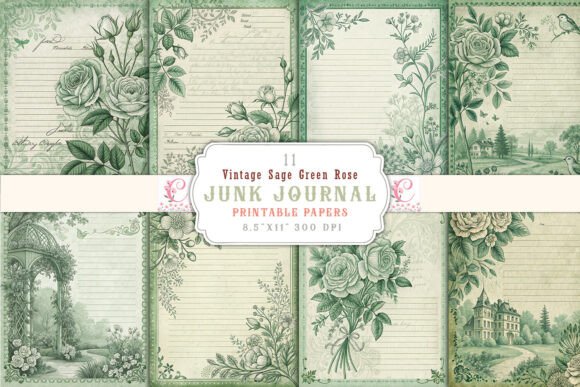
Understanding the visual characteristics of the Vintage Sage Green Rose Junk Journal is essential for utilizing it effectively. The defining feature here is the specific shade of green. Sage is a grey-green, a "dusty" tone that lacks the harshness of emerald or the acidity of lime. In color psychology, sage green is associated with wisdom, nature, and renewal. When paired with the imagery of roses—often rendered in soft pinks, creams, or faded reds—it creates a high-contrast yet harmonious palette. This interplay between the cool, matte background of the sage and the warm, delicate texture of the roses produces a "shabby chic" aesthetic that feels timeless rather than dated.
The "junk journal" aspect implies a layer of texture and imperfection. Unlike a clean, digital vector, these files—provided as high-resolution JPGs—likely feature subtle grain, paper fibers, and distressed edges. This texture is vital. In modern typography and layout design, flat colors can often feel sterile. The Vintage Sage Green Rose Junk Journal adds depth and tactile quality to digital projects, mimicking the look of premium, heavy-stock paper. This makes it an ideal backdrop for both serif and sans serif fonts, providing enough visual interest to be engaging but not so much noise that it compromises legibility.
Strategic Applications: Beyond the Craft Table
While the collection is perfect for traditional scrapbooking and memory keeping, its utility extends far into the realm of professional design and branding. The included files—8.5 x 11 inches at 300 DPI—offer the resolution required for high-quality print reproduction, making them suitable for commercial packaging design and editorial layouts.
Brand Identity and Packaging Design
For small business owners in the wellness, beauty, or artisanal food sectors, brand perception is everything. The Vintage Sage Green Rose Junk Journal aesthetic communicates specific values: organic ingredients, handmade quality, and attention to detail. Imagine a candle maker or a herbal tea brand using these botanical prints as the background for their logo design or product labels. The vintage floral pattern acts as a silent ambassador for the brand, suggesting that the product inside is natural and crafted with care. It moves a brand identity away from the generic "corporate" look and toward a more personalized, cottage-garden feel.
Digital Marketing and Social Media Graphics
In the fast-paced environment of social media, stopping the scroll is paramount. The soft, earthy tones of sage green are currently trending across platforms like Instagram and Pinterest, often categorized under "cottagecore" or "dark academia" aesthetics. Content creators can utilize these pages as backgrounds for quote graphics, promotional announcements, or story highlights. Because the background is visually rich but tonally muted, it provides excellent contrast for text overlays. A bold, modern sans serif font in white or charcoal placed over a Vintage Sage Green Rose Junk Journal page creates a striking visual hierarchy that is easy to read and aesthetically pleasing.
Editorial Design and Publishing
For authors, bloggers, and publishers, the visual presentation of content can influence how the text is received. These botanical printable papers are excellent for creating chapter dividers in eBooks, printable inserts for planners, or decorative elements for a zine. The Victorian floral writing pages, in particular, offer a sophisticated backdrop for poetry or journaling prompts. When designing a digital magazine or a PDF lead magnet, using these textures elevates the perceived value of the document, transforming a standard PDF into a premium digital experience.
Technical Workflow and Practical Integration
Integrating a Vintage Sage Green Rose Junk Journal into your workflow requires a bit of technical awareness to ensure the final output is polished. The files are delivered in a ZIP folder as high-resolution JPGs. This format is universally compatible with software ranging from Adobe Photoshop and Illustrator to Canva and Procreate.
Layering and Opacity: The true power of a junk journal page lies in its ability to be layered. In your design software, do not treat these images as static backgrounds. Place a Vintage Sage Green Rose Junk Journal page at the bottom of your canvas. Then, add a semi-transparent white layer over it (perhaps at 30% opacity) before placing your text. This technique retains the texture of the paper while increasing the legibility of your typography, ensuring that the intricate rose patterns do not compete with your message.
Color Harmony: When selecting typefaces to pair with these pages, consider the color theory at play. Because sage green is a complex, mixed tone, it pairs beautifully with other desaturated colors. Think warm greys, muted golds, and deep burgundies. Avoid using neon or overly saturated primary colors, as they will clash with the vintage vibe. A handwritten font or a script font can mimic the organic nature of the roses, while a clean serif font provides a grounding, readable counterpoint.
Evaluating Fit for Commercial and Personal Projects
Before committing to a design direction, it is crucial to evaluate whether the Vintage Sage Green Rose Junk Journal style aligns with your specific project goals. This collection is not a one-size-fits-all solution for every brand, but for the right audience, it is a powerful asset.
Target Audience Alignment: If your target demographic includes individuals who value nostalgia, femininity, nature, or artisanal craftsmanship, this aesthetic will resonate deeply. It appeals to a sense of slow living and appreciation for the past. Conversely, if you are designing for a high-tech startup or a futuristic SaaS company, a floral vintage journal page might send mixed signals about the brand's innovation.
Testing and Iteration: Treat these files as design assets, not just decoration. Experiment with cropping. A single corner of a rose illustration might be all you need to frame a logo. Zoom in on the texture to create a subtle background for a website header. The versatility of the Vintage Sage Green Rose Junk Journal lies in its ability to be deconstructed and repurposed. Do not be afraid to manipulate the saturation or contrast to better match your specific color palette while retaining the essence of the botanical print.
Ultimately, the Vintage Sage Green Rose Junk Journal is more than a set of printable papers; it is a mood board in a box. It offers a cohesive visual language that can unify disparate elements of a project, from the macro-level brand strategy down to the micro-level details of a tag or a sticker. By leveraging the timeless appeal of sage green and the romanticism of Victorian florals, you can create designs that feel both grounded in history and relevant to contemporary tastes.